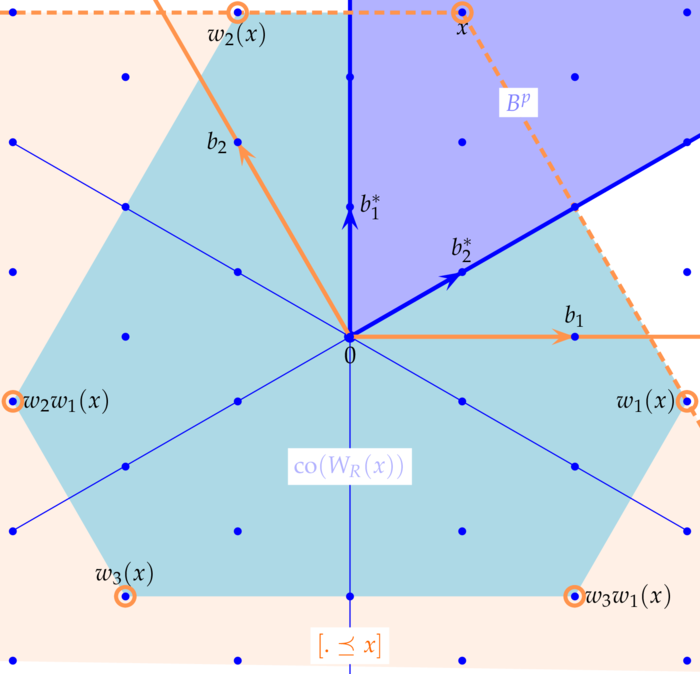
Root Systems
Any root system must be symmetric. For any reflection $R_x^2=1$ and thus $R_x(R)=R$, i.e. every element of the Weyl group just permutes the roots. $W_R$ must therefore be isomorphic to both a sub-group of the group of permutations of $R$ and a sub-group of $\OO(E)$. Geometrically the forth condition says that for any pair of roots $x,y$ twice the component of $y$ in the direction $x$ is an integer. Moreover $$ R_x(y)=y-\frac{2\la x,y\ra}{\Vert x\Vert^2}x=y-nx \quad\mbox{for some $n\in\Z$}~. $$ Suppose both $(R,E)$ and $(S,F)$ are root systems, then $R\cup S$ is a root system in $E\oplus F$. We simply check two details: 1. For $x\in R$ and $y\in S$ we have $R_x(y)\in R\cup S$, which follows from the fact that $x\perp y$ and thus $R_x(y)=y$. 2. For $x\in R$ and $y\in S$ we have $2\la x,y\ra/\Vert x\Vert^2\in\Z$, which is obvious, as $\la x,y\ra=0$. $\proof$ Put $m\colon=2\la x,y\ra/\Vert x\Vert^2$ and $n\colon=2\la y,x\ra/\Vert y\Vert^2$, then $m,n\in\Z$ and denoting by $\a$ the angle between $x$ and $y$: $mn=4\cos^2\a$ and $n/m=\Vert x\Vert^2/\Vert y\Vert^2\geq1$. This implies that $|m|\leq|n|$ and $mn\in\{0,1,2,3,4\}$ and thus $\cos^2\a\in\{0,1/4,1/2,3/4,1\}$. However $\cos^2\a=1$ implies that $x$ and $y$ are col-linear. Therefore $\cos^2\a\in\{0,1/4,1/2,3/4\}$ and $mn\in\{0,1,2,3\}$. Suppose $mn=3$; since $|m|\leq|n|$ we must have: $(|m|,|n|)=(1,3)$, which implies that $\Vert x\Vert^2/\Vert y\Vert^2=|n|/|m|=3$. The other cases are similar. $\eofproof$ $\proof$ In any case $x$ and $y$ are not col-linear and they are not orthogonal to each other. Moreover, w.l.o.g. we may assume that $\Vert x\Vert\geq\Vert y\Vert$. This implies under the first condition that $m,n\in\N$, $m\leq n$ and $mn\in\{1,2,3\}$. The only possible value for $m$ is $1$. Therefore $R_x(y)=y-mx=y-x$. The second case is similar. $\eofproof$ $\proof$ Let $x^\vee\colon=2x/\Vert x\Vert^2$ be the co-root of $x\in R$. We only check the forth property: $$ \frac{2\la x^\vee,y^\vee\ra}{\Vert x^\vee\Vert^2} =\frac{8\la x,y\ra\Vert x\Vert^4}{4\Vert x\Vert^2\Vert y\Vert^2\Vert x\Vert^2} =\frac{2\la x,y\ra}{\Vert y\Vert^2}\in\Z $$ Moreover $$ \Big(\frac{2\la x^\vee,y^\vee\ra}{\Vert x^\vee\Vert^2},\frac{2\la x^\vee,y^\vee\ra}{\Vert y^\vee\Vert^2}\Big) =\Big(\frac{2\la x,y\ra}{\Vert y\Vert^2},\frac{2\la x,y\ra}{\Vert x\Vert^2}\Big) =(n,m)\in\Z^2~. $$ $\eofproof$Bases and Weyl Chambers
Base of a root system
A subset $B$ of a root system $R$ in $E$ is said to be a base if
Does every root system $R$ contain a base? First we notice that for any basis $B$ for $E$ there is some unit vector $h\in E$ such that $B\sbe[\la.,h\ra > 0]$. In the sequel we will show that given a unit vector $h\in E$ such that $R\cap[\la.,h\ra = 0]=\emptyset$ there is exactly one basis $B\sbe R^+\colon=R\cap[\la.,h\ra > 0]$ such that
$$
R^+\sbe\sum_{b\in B}\N_0 b,
$$
i.e. each unit vector $h\in E$ such that $R\cap[\la.,h\ra = 0]=\emptyset$ splits $R$ into two disjoint sets $R^+=R\cap[\la.,h\ra > 0]$ and $-R^+$ and determines a unique base $B\sbe R^+$. Thus given such a unit vector $h$ an obvious candidate for a base is a set of minimal cardinality in
$$
\B\colon=\Big\{B\sbe R^+:R^+\sbe\sum_{b\in B}\N_0 b\Big\}
$$
which exists, because $R^+\in\B$ and thus $\B$ is not empty. Let $B$ be a minimal set in $\B$. Since $R=R^+\cup -R^+$ and $R$ spans $E$ we have $\lhull{B}=E$. Moreover, minimality implies that:
$$
\forall x\in B:\quad x\notin\sum_{b\in B\sm\{x\}}\N_0 b~.
$$
We say that every vector in $B$ is in-decomposable in $B$. Next we will show an important property of a minimal set $B$:
1. For all $b_1\neq b_2\in B$ we have $\la b_1,b_2\ra\leq0$: Assume to the contrary that for some pair $b_1\neq b_2$: $\la b_1,b_2\ra > 0$. Since $b_1\neq b_2$ we infer that the angle between $b_1$ and $b_2$ is in the range $(0,\pi/2)$. By corollary we may assume w.l.o.g. that $b_1-b_2\in R^+$; i.e.
$$
(1-n(b_1))b_1-b_2=\sum_{b\neq b_1}n(b)b~.
$$
If $n(b_1) > 0$, then $0 < \la(1-n(b_1))b_1-b_2,h\ra=\sum_{b\neq b_1}n(b)\la b,h\ra\geq0$. Otherwise $b_1$ is not in-decomposable.
2. If $B\sbe[\la.,h\ra > 0]$ is any collection of non zero vectors such that for all $b_1\neq b_2\in B$: $\la b_1,b_2\ra\leq0$, then $B$ is linearly independent: Suppose $0=\sum_b\a(b)b$ and put
$$
x\colon=\sum_{[\a > 0]}c(b)b=\sum_{[\a < 0]}-c(b)b~.
$$
Then, as $[\a > 0]\cap[\a < 0]=\emptyset$ we get by assumption:
$$
\Vert x\Vert^2=\sum_{\a(b_1) > 0,\a(b_2) < 0}-\a(b_2)\a(b_1)\la b_1,b_2\ra\leq0,
$$
i.e. $x=0$ and thus: $\sum_{\a > 0}\a(b)\la b,h\ra=\sum_{\a < 0}-\a(b)\la b,h\ra=0$; as $B\sbe[\la.,h\ra > 0]$ this implies that $\a(b)=0$ for all $b$.
By 1. and 2. any minimal set $B$ in $\B$ is indeed a base for $R$ and thus it remains to verify uniqueness: Suppose $D\sbe R^+$ is another base, then any $b\in B$ is in $\sum_{d\in D}\N_0d$ and any $b\in B$ is in $\sum_{b\in B}\N_0b$. Thus there are matrices $X,Y\in\Ma(\dim E,\N_0)$ such that $XY=1$. But the only matrices with these properties are permutation matrices, i.e. $D$ is just a permutation of $B$.
$\sum_l x_{jl}y_{lj}=1$: this means that for each $j$ there is exactly one $k$ such that $x_{jk}=y_{kj}=1$. We claim that $j\mapsto k$ is injective: Suppose for $i\neq j$: $x_{jk}=y_{kj}=1=x_{ik}=y_{ki}$, then $2=y_{kj}x_{jk}+y_{ki}x_{ik}\leq(YX)_{kk}=1$.- $B$ is a basis for the vector space $E$.
- For each $x\in R$ either $x\in\sum_{b\in B}\N_0 b$ or $-x\in\sum_{b\in B}\N_0 b$.
For $m\neq j$ we have: $\sum_l x_{ml}y_{lj}=0$; in particular $x_{mk}=0$ for all $m\neq j$. Thus the $k$-th column of $X$ has exactly one entry $1$ in the $j$-th row and all other entries are $0$. Hence $X$ is a permutation matrix and so is $Y=X^{-1}$. Of course, a base $B$ is in-decomposable, the following exam is about a somewhat stronger property: Assume $b=\sum_{x\in R_1^+}\a(x)x$ for some subset $R_1^+\sbe R^+$ with $\a(x) > 0$. Now for all such $x$ we have: $$ x =\sum_{c\in B} n_x(c)c \quad\mbox{where $n_x(c)\in\N_0$} $$ and thus $$ b =\sum_{x\in R_1^+}\sum_{c\in B}\a(x)n_x(c)c =\sum_{c\in B}\Big(\sum_{x\in R_1^+}\a(x)n_x(c)\Big)c~. $$ Since $B$ is a basis, we must have $\sum_{x}\a(x)n_x(b)=1$ and for all $c\neq b$: $\sum_{x}\a(x)n_x(c)=0$. Hence for all $c\neq b$ and all $x\in R_1^+$: $\a(x)n_x(c)=0$, i.e. $n_x(c)=0$. The only possible non zero coefficient in the expansion of any $x\in R_1^+$ is $n_x(b)$. This means that $x=n_x(b)b$, but the only multiple of $b$, which is in $R^+$ is $b$. Choose a unit vector $h\in E$ such that $\la r,h\ra > 0$ and for all $x\in R^+\colon=R\cap[\la.,h\ra > 0]$ different from $r$: $\la x,h\ra > \la r,h\ra$. Then $$ r\notin\sum_{x\in R^+}\N_0x, $$ for $r=\sum n(x)x$ implies $\la r,h\ra=\sum n(x)\la x,h\ra > (\sum n(x))\la r,h\ra$, i.e. $\sum n(x) < 1$. Suppose $r\in R^+\sm\{b\}$, then for some non empty subset $B^\prime$ of $B\sm\{b\}$: $$ r=\sum_{x\in B^\prime}c(x)x+c(b)b \quad\mbox{and}\quad c(x)\in\N, c(b)\in\N_0~. $$ Now for each $r\in R$: $R_b(r)=r-nb$ for some $n\in\Z$ and therefore $$ R_b(r)=\sum_{x\in B^\prime}c(x)x+(c(b)-n)b\in R $$ As $R=R^+\cup R^-$, $B^\prime\neq\emptyset$ and $c(x) > 0$, $R_b(r)$ cannot belong to $R^-$. Hence we must have $R_b(r)\in R^+$ - and therefore we must also have $c(b)\geq n$. If $B$ is a base for $R$, then it`s not at all obvious that $B^\vee$ is a base for $R^\vee$, because if $r=\sum n(b)b\in R^+$, then $$ r^\vee =\sum_{b\in B}\frac{2n(b)b}{\Vert r\Vert^2} =\sum_{b\in B}\frac{n(b)\norm b^2}{\Vert r\Vert^2}b^\vee $$ However the statement is true and thus in particular $$ \forall b\in B\,\forall r=\sum n(b)b\in R^+:\quad \frac{n(b)\norm b^2}{\Vert r\Vert^2}\in\N_0~. $$ $\proof$ By proposition we know that $R^\vee$ is a root system in $E$. As $B$ is a basis for $E$, $B^\vee$ is a basis for $E$ and if $B\sbe[\la .,h\ra > 0]$, then $B^\vee\sbe[\la .,h\ra > 0]$. Moreover, the set of positive roots of $R^\vee$ coincides with the set $R^{+\vee}\colon=\{x^\vee:x\in R^+\}$ and therefore there is a unique base $C\sbe R^{+\vee}$ for the root system $R^\vee$ such that $$ R^{+\vee}\sbe\sum_{c\in C}\N_0c~. $$ Assume that there is some $x\in R^+\sm B$ such that $x^\vee\in C$. Now $x$ can be written as $x=\sum_{b\in B}n(b)b$ - at least two of the coefficients $n(b)\in\N_0$ are different from $0$. Thus $$ x^\vee =\sum_{b\in B}\frac{2n(b)}{\Vert x\Vert^2}b =\sum_{b\in B}\frac{n(b)\Vert b\Vert^2}{\Vert x\Vert^2} b^\vee \in\sum_{b^\vee\in B^\vee}\R_0^+b^\vee~. $$ But by exam any $x^\vee$ in the base $C$ cannot lie in the positive convex cone generated by $R^{+\vee}\sm\{x^\vee\}$, which is a superset of $B^\vee$. Hence our assumption that there is some $x\in R^+\sm B$ such that $x^\vee\in C$ is false, i.e. $C\sbe B^\vee$ and as both are bases: $C=B^\vee$. $\eofproof$
$H_1$ and $H_2$ form a base for the root system $\{\pm H_1,\pm H_2,\pm H_3\}$ of $\sla(3,\C)$, cf. e.g. section.
Find a base $B$ of the root system of $\sla(n,\C)$ given in exam and describe $R^+$. Show that for any vector $x=\sum x_je_j$ such that $x_1 > x_2 > \cdots > x_n$ we have $R^+=\{r\in R:\la r,x\ra > 0$.
$E\colon=\{x\in\R^n:\la x,N\ra=0\}$, where $N=e_1+\cdots+e_n$. Put for $k=1,\ldots,n-1$: $b_k\colon=e_k-e_{k+1}$. Then for $j < k$: $e_j-e_k=b_j+\ldots+b_{k-1}$, i.e. $b_1,\ldots,b_{n-1}$ is a base and $R^+=\{e_j-e_k:j < k\}$. Finally for $j < k$: $\la e_j-e_k,x\ra=x_j-x_k > 0$.
Referring to exam we conclude from the above exam: $H_1=E^{11}-E^{22},\ldots,H_{n-1}=E^{n-1,n-1}-E^{nn}$.
$E=\R^n$. Put for $k=1,\ldots,n-1$: $b_k\colon=-e_k+e_{k+1}$ and $b_n=e_1+e_2$. Then $-e_j+e_k=b_j+\ldots+b_{k-1}$, $e_1+e_k=b_n+(-e_1+e_k)$ and for $j=2,\ldots,k-1$: $e_j+e_k=(e_{j-1}+e_k)+b_{j-1}$.
The dual root system of $\so(2n+1,\C)$ is isometric to the root system of $\spa(n,\C)$. Cf. exam and exam
Weyl chambers
Given a root system $R$ in $E$ an open Weyl chamber is a connected component of the set
$$
E\sm\bigcup_{r\in R}[\la.,r\ra=0]~.
$$
If $B$ is a base for $R$, then the sets
$$
C\colon=\bigcap_{b\in B}[\la.,b\ra\geq0]
\quad\mbox{and}\quad
C^\circ=\bigcap_{b\in B}[\la.,b\ra > 0]
$$
are said to be the closed and open fundamental Weyl chambers in $E$ relative to $B$. Cf. H. Weyl.
Since any base $B$ is a basis, a fundamental Weyl chamber $C$ is a convex cone with vertex $0$ and non empty interior $C^\circ$, thus $C^\circ$ is an open convex cone - hence it`s connected. We claim that for all roots $r$ the function $x\mapsto\la x,r\ra$ doesn`t change sign on $C^\circ$: indeed, $r=\pm\sum_{b\in B_1}n(b)b$, $\emptyset\neq B_1\sbe B$, $n(b) > 0$ and for all $x\in C^\circ$: $\la x,b\ra > 0$. Hence for all $r\in R$: $[\la.,r\ra=0]\cap C^\circ=\emptyset$ and this shows that $C^\circ$ is an open Weyl chamber limited by the hyperspaces $[\la.,b\ra=0]$, $b\in B$. So open fundamental Weyl chambers are open Weyl chambers.
Also, since $B$ is a base: $R^+\sbe\sum_{b\in B}\N_0b$ and thus for all $x\in C^\circ$ and all $r\in R^+$: $\la x,r\ra > 0$, i.e.
\begin{equation}\label{bwceq1}\tag{BWC1}
R^+\sbe R\cap\bigcap_{x\in C^\circ}[\la x,.\ra > 0]~.
\end{equation}
Next we will show that this inclusion is in fact an equality. We need the following result, which is just a special case of the bi-polar theorem in locally convex spaces. However, we don`t need to invoke the Hahn-Banach theorem, because in a real Hilbert space $E$ for any closed convex set $C$ and any point $x_0\neq0$, $x_0\notin C$, there is a vector $y\in E$ such that $\la x_0,y\ra < -1$ and for all $x\in C$: $\la x,y\ra\geq-1$: for $y$ you may choose a multiple of $x_1-x_0$, where $x_1\in C$ is the best approximation of $x_0$ within $C$!
$\proof$
Obviously, $A^p,C^p$ are closed and convex and $A^p\spe C^p$.
1. Clearly $A^{pp}$ is a closed convex subset containing $A$ and $0$, i.e. $C\sbe A^{pp}$. Assume that there is some point $x_0\in A^{pp}$ such that $x_0\notin C\colon=\cl{\convex{A\cup\{0\}}}$. Then there is a vector $y_0\in E$ such that:
$$
\la x_0,y_0\ra < -1,\quad\mbox{and}\quad
\forall x\in C:\quad\la x,y_0\ra\geq-1~.
$$
Hence $y_0\in C^p=A^p$ and thus $x_0\notin A^{pp}$.
2. Again, if $y_0\in A^p\sm C^p$, then there is $x_0\in E$ such that $\la y_0,x_0\ra < -1$ and for all $y\in C^p$: $\la y,x_0\ra\leq-1$, i.e. $x_0\in C^{pp}$ and $x_0\notin A^{pp}$, which is impossible by 1.
3. If $A$ is a cone with vertex $0$, then for all $x\in A$ and all $\l > 0$: $\l x\in A$. Hence for all $y\in A^p$: $\la x,y\ra\geq -1/\l$, i.e. $\la x,y\ra\geq0$.
$\eofproof$
By definition we have for the fundamental Weyl chamber $C$ relative to the base $B$:
$$
C=B^p=R^{+p}
\quad\mbox{and}\quad
\sum_{b\in B}\R_0^+b
=\cl{\convex{B\cup\{0\}}}
=B^{pp}~.
\quad\mbox{i.e.}\quad
\sum_{b\in B}\R^+b=B^{pp}\sm\{0\}~.
$$
$\proof$
Let $D$ be the closed convex cone generated by $R^+$, then $R^+=R\cap D$ and by lemma: $C^p=D$. Hence $C^p\cap R=R^+$. Since $C$ is closed and convex with non empty interior, we have: $\cl{C^{\circ}}=C$ and therefore by lemma: $C^{\circ p}=C^p$. It follows that
$$
\bigcap_{x\in C^\circ}[\la x,.\ra > 0]
\sbe\bigcap_{x\in C^\circ}[\la x,.\ra\geq0]
=C^{\circ p}
=C^p~.
$$
On the other hand we always have by \eqref{bwceq1}: $R^+\sbe R\cap\bigcap_{x\in C^\circ}[\la x,.\ra > 0]$.
$\eofproof$
Not all subsets of a root system $R$, which form a basis of the vector space $E$, constitute a base for $R$. However, the subsequent result shows that every open Weyl chamber $W$ of $R$ is an open fundamental Weyl chamber:
$\proof$
Choose $x_0\in C$, then the hyperspace $[\la.,x_0\ra=0]$ doesn`t contain any root. Hence there is a base $B$ of $R$ such that $B\sbe[\la.,x_0\ra > 0]$. On the other hand for all roots $r$ the functions $x\mapsto\la r,x\ra$ don`t change sign on $C$ and as these signs are $+1$ at $x_0$ for all $r=b\in B$ these signs are $+1$ for all $b\in B$ and all $x\in C$. Hence $C\sbe B^p$ and as $C$ is a connected component: $C=B^{p\circ}$
We are left to prove uniqueness: Suppose $D$ is another base, then $D^p=B^p$ and therefore both bases have the same system of positive roots. But this system of positive roots contains just one base.
$\eofproof$
As any $w\in W_R$ maps a base onto a base, $w(B)$ is a base and $y\in w(B)^p$ iff for all $b\in B$: $0\leq\la x,w(b)\ra=\la w^{-1}(x),b\ra$, i.e. iff $w^{-1}(x)in B^p$.
Weyl Chambers and the Weyl group
Put $\dim E=n+1$ and let us denote by $S^n$ the unit sphere $\{x\in E:\Vert x\Vert=1\}$. We look at the set $\Sigma_n$ of all intersection $C\cap S^{n-1}$ of Weyl chambers $C$ of a root system $R$ in $E$. Each of these sets is limited by $n+1$ hyperspaces and is thus an $n$-simplex on the sphere $S^n$. The set $\Sigma$, consisting of all sub-simplices of $\Sigma_n$ is a so called triangulation of $S^n$, i.e. the intersection of two simplices in $\Sigma$ is again a simplex in $\Sigma$. Moreover the pair $(S^n,\Sigma)$ is a pseudo-manifold, which means that:- Every simplex is a sub-simplex of an $n$-simplex.
- Every $(n-1)$-simplex is a sub-simplex of exactly two $n$-simplices.
- For each pair $S,T$ of $n$-simplices there is a sequence $S,S_1,\ldots,S_k,T$ of $n$-simplices, such that each pair of consecutive $n$-simplices has a common $(n-1)$-simplex.
Integral and Dominant Elements
Given a root system $R$ in $E$ a vector $x\in E$ is said to be an integral element if for all roots $r\in R$:
$$
\la x,r^\vee\ra\colon=\frac{2\la x,r\ra}{\Vert r\Vert^2}\in\Z~.
$$
If $B$ is a base for $R$ a vector $x\in E$ is said to be a dominant element or a strictly dominant element if $x\in B^p$ or $x\in B^{p\circ}$, i.e.
$$
\forall b\in B:\quad\la x,b^\vee\ra\geq0
\quad\mbox{or}\quad
\la x,b^\vee\ra > 0
$$
Every root and thus every element in $\sum_{r\in R}\Z r$ is integral, but not every integral element is a root!
For a vector $x\in E$ to be integral it suffices to check that $\la x,r^\vee\ra\in\Z$ for all $r$ in a base $B$. This is because by proposition the set $B^\vee$ is a base for the dual root system $R^\vee$ and thus for any $r\in R$ the vector $r^\vee$ is a linear combination of elements in $B^\vee$ with integer coefficients.
By corollary we have for each $x\in E$: $|W_R(x)\cap B^p|=1$, i.e. there is a unique element $y=w(x)\in B^p$; in other words, the $W_R$-orbit of $x$ contains a unique dominant element.
For any reflection $\s$ about a root $s$ we have: $\s(x)=x-\la x,s^\vee\ra s$, i.e. $\s(x)$ is integral. If $\t$ is another reflection about $r$, then
$$
x-\t\s(x)
=(x-\s(x))+(\s(x)-\t\s(x))
\in\sum_{r\in R^+}\Z r+\sum_{r\in R^+}\Z r
=\sum_{r\in R^+}\Z r
$$
As the reflections generate $W_R$ the conclusion follows.
Given a base $B$ of a root system $R$ the element
\begin{equation}\label{ideeq1}\tag{IDE1}
r_0\colon=\tfrac12\sum_{r\in R^+}r
\end{equation}
is integral and strictly dominant: we have to check only one property: for all $b\in B$: $\la r_0,b^\vee\ra\in\N$. Indeed we will show that
\begin{equation}\label{ideeq2}\tag{IDE2}
\forall b\in B:\qquad
\la r_0,b^\vee\ra=1.
\end{equation}
We split $R^+\sm\{b\}$ as follows: the first set $R_1^+$ comprises all vectors orthogonal to $b$ and the second set $R_2^+$ the vectors not orthogonal to $b$. Then we get
$$
\la r_0,b^\vee\ra
=\tfrac12\Big(\la b,b^\vee\ra+\sum_{r\in R_2^+}\la r,b^\vee\ra\Big)~.
$$
Now by exam the reflection $R_b$ permutes $R_2^+$ and for all $r\in R_2^+$:
$$
\la R_b(r),b^\vee\ra
=\la r,R_b(b^\vee)\ra
=-\la r,b^\vee\ra
$$
i.e. $R_2^+$ can be represented as the pairwise disjoint union of pairs $\{r,R_b(r)\}$. It follows that the sum over $R_2^+$ vanishes and thus $\la r_0,b^\vee\ra=\tfrac12\la b,b^\vee\ra=1$.
We use $R^+=\{e_j-e_k: j < k\}$:
$$
2r_0=\sum_{j < k}e_j-e_k=(n-1)e_1+(n-3)e_2+\cdots+(1-n)e_n~.
$$
Let $B$ be a base for $R$. The dual basis to $B^\vee$ is said to be the fundamental weight system relative to $B$.
The fundamental weight system is a generating set of the convex cone $B^p$: obviously for any $b\in B$: $b^{\vee*}\in B^p$. Conversely for any $x\in B^p$ we have
$$
x=\sum\la x,b^\vee\ra b^{\vee*}
\quad\mbox{and}\quad
\la x,b^\vee\ra\geq0,
$$
Hence, normalizing a fundamental weight system we get the vertices of the $n$-simplices of the triangulation $\Sigma_n$ of $S^{n-1}$ associated to the base $B$.
In theorem we will show that all weights of finite dimensional irreducible representations of a semi-simple Lie-algebra are integral.
1. $H$ is a base for the root system of $\sla(2,\C)$ satisfying $H^\vee=H$ and the dual basis is $\l_1=H/2$. Hence $\l$ is integral iff $\l\in\frac12\Z H$.
2. $H_1,H_2$ is a base for the root system of $\sla(3,\C)$ satisfying $H_j^\vee=H_j$ and the dual basis is $\l_1=Q,\l_2=Y$, i.e. charge and hypercharge. Cf. exam. Hence $\l$ is integral iff $\l\in\Z Q+\Z Y$.
By exam we know that $b_k^\vee=b_k\colon=e_k-e_{k+1}$, $k=1,\ldots,n-1$, is a base in $E\colon=\{x\in\R^n:\la x,N\ra=0\}$, where $N=e_1+\cdots+e_n$. As $b_k^\vee=b_k$ we simply need to check that $b_1^*,\ldots,b_{n-1}^*$ is indeed the dual basis of $b_1,\ldots,b_{n-1}$ in $E$.
$$
\la b_j^*,b_j\ra=1-\tfrac jn+\tfrac jn=1
$$
For $j < k$: $\la b_j^*,b_k\ra=-\tfrac jn+\tfrac jn=0$ and for $j > k$: $\la b_j^*,b_k\ra=(1-\tfrac jn)-(1-\tfrac jn)=0$.
Referring to exam we conclude from the above exam that a fundamental weight system in the Cartan algebra ${\cal H}$ of traceless diagonal matrices of $\sla(n,\C)$ - the dual system to $H_1,\ldots,H_{n-1}$ - is given by
$$
\forall j=1,\ldots,n-1:\quad
\l_j\colon=(1-\tfrac jn)\sum_{l=1}^jE^{ll}-\tfrac jn\sum_{l=j+1}^nE^{ll}~.
$$
In particular for $n=2$: $\l_1=H/2$ and for $n=3$: $\l_1=(2/3)E^{11}-(1/3)(E^{22}+E^{33})=Q$ and $\l_2=(1/3)(E^{11}+E^{22})-(2/3)E^{33}=Y$.
Partial Ordering Integral Elements
Suppose $B$ is a base for $R$ in $E$. We introduce a partial order on $E$, which obviously depends on the base $B$, i.e. it depends on the choice of a positive root system $R^+$:
$$
x\preceq y:\Lrar y-x\in\sum_{b\in B}\R_0^+b=\sum_{r\in R^+}\R_0^+r~.
$$
$y\in E$ is said to be higher than $x\in E$ or $x$ is lower than $y$.
Compare definition. In this section we always assume that we`ve chosen a fixed base or a fixed set of positive roots for a root system!
$\proof$
Suppose that $x$ is dominant, i.e. $x\in B^p$. As $B$ is a basis for $E$, we have a unique decomposition
$$
x=\sum_{b\in B}\la x,b^*\ra b
$$
where $\{b^*:b\in B\}$ denotes the dual basis. Expanding $b^*$ in terms of the basis $B$ we get:
$$
b^*=\sum_{c\in B}\la b^*,c^*\ra c
\quad\mbox{and therefore}\quad
x=\sum_{c,b\in B}\la b^*,c^*\ra\la x,c\ra b~.
$$
Now $x$ is dominant, i.e. $x\in B^p$, which means that for all $c\in B$: $\la x,c\ra\geq0$. To finish the proof we need to verify that for all $c,b\in B$: $\la b^*,c^*\ra\geq0$, which will be done in the subsequent lemma.
$\eofproof$
$\proof$
We proceed by induction on the dimension $n$: For $n=2$ this is just exam. So assume the assertion is true for dimension $n\geq2$. Choose $j < k$ in $\{1,\ldots,n,n+1\}$ and select any number $m$ in $\{1,\ldots,n,n+1\}\sm\{j,k\}$ - this is possible, as $n+1\geq3$. W.l.o.g. assume $m=n+1$. Denote by $P$ the orthogonal projection onto the sub-space $F$ orthogonal to $x_{n+1}$, i.e.
$$
Px=x-\frac{\la x,x_{n+1}\ra}{\Vert x_{n+1}\Vert^2}x_{n+1}
$$
As for all $l\leq n$: $\la x_l^*,x_{n+1}\ra=0$, we have for all $l\leq n$: $Px_l^*=x_l^*$. Orthogonal projections are self-adjoint, hence we get
$$
\forall l,m\leq n:\quad
\la x_l^*,Px_m\ra=\la Px_l^*,x_m\ra=\la x_l^*,x_m\ra=\d_{lm},
$$
i.e. $Px_m$, $m\leq n$, is the dual basis for the basis $x_l^*$, $l\leq n$, of $F$. Since for all $l\leq n$: $\la x_l,x_{n+1}\ra < 0$ we finally have for all $l,m\leq n$:
\begin{eqnarray*}
\la Px_l,Px_m\ra
&=&\la x_l,Px_m\ra
=\Big\langle x_l,x_m-\frac{\la x_m,x_{n+1}\ra}{\Vert x_{n+1}\Vert^2}x_{n+1}\Big\rangle\\
&=&\la x_l,x_m\ra-\frac{\la x_m,x_{n+1}\ra\la x_l,x_{n+1}\ra}{\Vert x_{n+1}\Vert^2}
< \la x_l,x_m\ra < 0~.
\end{eqnarray*}
By induction hypothesis this implies in particular: $\la x_j^*,x_k^*\ra > 0$.
$\eofproof$
For all $l\leq r$:
$$
Px_l
=\sum_{j,k=1}^rg^{jk}\la x_l,x_j\ra x_k
=\sum_{j,k=1}^rg^{jk}g_{lj}x_k
=\sum_{k=1}^r\d_{lk}x_k
=x_l
$$
i.e. $P|F=id$. Analogously we get
$$
\la Px,x_l\ra
=\sum_{j,k=1}^rg^{jk}\la x,x_j\ra\la x_k,x_l\ra
=\sum_{j,k=1}^rg^{jk}g_{kl}\la x,x_j\ra
=\sum_{j,k=1}^r\d_{jl}\la x,x_j\ra
=\la x,x_l\ra
$$
i.e. $(1-P)x\in F^\perp$. Thus $P$ is indeed the orthogonal projection. On the other hand we have for all $l=1,\ldots,r$:
$$
x_l=\sum_{j,k}\la x_j^*,x_k^*\ra\la x_l,x_j\ra x_k
\quad\mbox{i.e.}\quad
g^{jk}=\la x_j^*,x_k^*\ra~.
$$
$$
\la u_j,u_k\ra
=\sum_{l,m=1}^nr^{lj}r^{mk}g_{lm}
=\sum_{l,m=1}^nr^{jl}g_{lm}r^{mk}
=(G^{-1/2}GG^{-1/2})_{jk}=\d_{jk}
$$
For the fundamental weight system of $\sla(n,\C)$ given in exam we have
$$
\forall j < k:\quad
\la b_j^{*},b_k^{*}\ra
=j(1-\tfrac kn)~.
$$
$\proof$
1. We know from corollary that the $W_R$-orbit $W_R(x)$ of $x$ contains a unique dominant element, which must be $x$. Split $W_R(x)$ into two sets: the first comprises all points comparable to $x$: for all these points $y$ we must have $y\preceq x$. The second set $P$ contains all points in the orbit $W_R(x)$ incomparable to $x$. Choose $p\in P$ maximal with respect to the order $\preceq$. We claim that $p\in B^p$, for otherwise there is some $b\in B$ such that $\la p,b\ra < 0$ and thus
$$
R_b(p)=p-\frac{2\la p,b\ra}{\norm b^2}b
$$
would be strictly higher than $p$. If $R_b(p)$ were not in $P$, then $p\preceq R_b(p)\preceq x$, i.e. $p\notin P$. But $R_b(p)\in P$ contradicts the maximality of $p$. Therefore we must have $p\in B^p$, i.e. $p$ is dominant and therefore $p=x$.
2. If $x$ is a strictly dominant integral element, then for all $b\in B$: $\la x,b^\vee\ra\in\Z\cap\R^+=\N$. Since for all $b\in B$: $\la r_0,b^\vee\ra=1$ it follows that for all $b\in B$: $\la x-r_0,b\ra\geq0$.
$\eofproof$
$\proof$
As $C$ is compact and convex and $y\notin C$ there is some $y_1\in E$ such that
$$
\la y_1,y\ra > \sup\{\la y_1,c\ra:\,c\in C\}~.
$$
However, $y_1$ is not necessarily dominant, but by corollary there exists $y_0=w_0(y_1)$ in the $W_R$-orbit of $y_1$, which is dominant. Now we have on the one hand
$$
\sup\{\la y_0,c\ra:\,c\in C\}
=\sup\{\la y_1,w_0^{-1}c\ra:\,c\in C\}
=\sup\{\la y_1,c\ra:\,c\in C\}~.
$$
On the other hand we get by proposition $y_0-y_1\in\sum_{r\in R^+}\R_0^+r$. Finally, as $y$ is dominant, we conclude that
$$
\la y_0,y\ra-\la y_1,y\ra
=\la y_0-y_1,y\ra
\in\sum_{r\in R^+}\R_0^+\la r,y\ra\sbe\R_0^+
$$
$\eofproof$
$\proof$